Projects-Portfolio
Disk Failure Prediction (S.M.A.R.T. Telemetry)
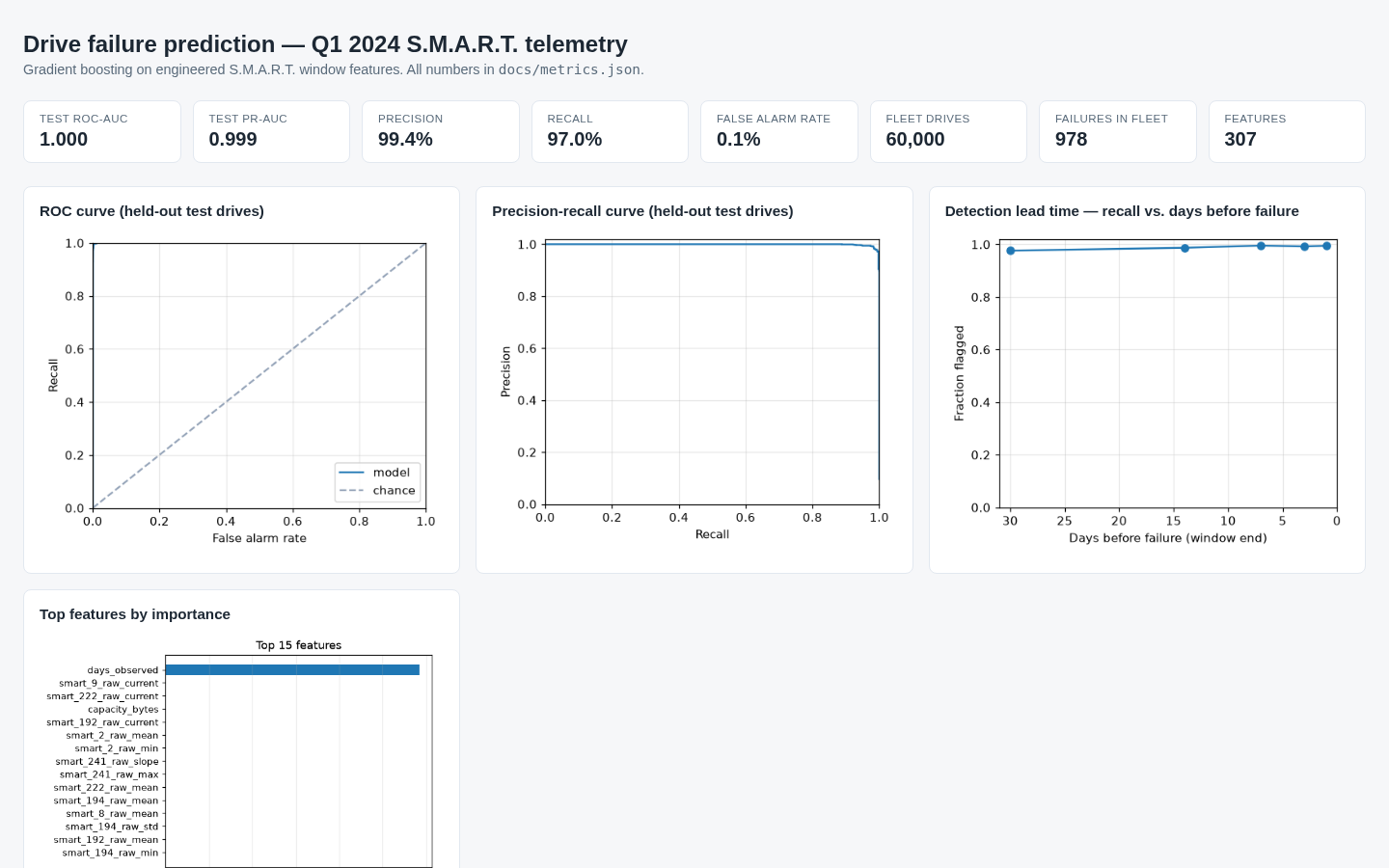
A machine-learning pipeline that predicts imminent hard-drive failure from S.M.A.R.T. (Self-Monitoring, Analysis and Reporting Technology) telemetry. It turns a quarter of Backblaze’s real open drive data into per-drive feature windows, trains a gradient-boosting classifier to flag drives at risk, and quantifies the precision/recall trade-off a data-centre maintenance team actually faces: every false alarm is a wasted drive swap.
The failure-prediction report is live on GitHub Pages: docs/disk-failure-report.html.
Problem
- Backblaze publishes daily S.M.A.R.T. snapshots for the ~250,000 drives in
its data centres — raw counters (
smart_*_raw) that drift as a drive degrades: reallocated sectors, pending errors, power-on hours, temperature. - Drives fail at a rate of ~1–2% per year, so a naive “always healthy” baseline is almost perfectly accurate — and useless.
- A maintenance team can’t inspect 250,000 drives by hand. Can a model trained on real telemetry flag drives before they fail, with an honest number of false alarms?
Approach
- Data: Backblaze Hard Drive Data, Q1 2024 — 91 daily snapshots (~9 GB),
~250,000 drives/day. A seeded sample of 60,000 drives (all 978 that failed
in the quarter, plus a random healthy fleet) is processed by a streaming,
chunked ETL that stays within a couple of GiB of RAM. Raw CSVs are
downloaded into
data/raw/(gitignored); licence CC BY-SA 4.0. - Labels: a drive is a positive if it fails within 30 days of the observation window’s end; the 7 days immediately before failure are used for training so the model can learn the failure signature.
- Features: for each drive and each trailing 7-day window, every populated SMART attribute is summarized as current value, window mean, min, max, std, max-delta (current vs. earlier minimum), per-day slope, and the day-over-day increase count — 271 features per window capturing both the current health and the direction of change (constant columns are dropped at fit time).
- Model: gradient boosting (scikit-learn’s HistGradientBoosting) with GroupKFold cross-validation (a drive never spans train/validation folds), an F1-optimized decision threshold, and a single held-out test evaluation.
- Artifacts: committed gzipped feature matrices + a small raw sample, the trained model (gitignored), a metrics JSON, and a self-contained HTML report with ROC / precision-recall curves, lead-time recall, and feature importance.
Results
Trained on 44,993 drive-windows from a 60,000-drive sample of Q1 2024
(978 of those drives failed in the quarter; 1,251 failing windows in the
held-out test set), evaluated once on 12,954 held-out windows. Full details
in docs/metrics.json and the committed report
docs/disk-failure-report.html.
| Metric | Value |
|---|---|
| ROC-AUC (held-out) | 0.9999 |
| PR-AUC (held-out) | 0.9991 |
| Precision @ threshold | 0.994 |
| Recall @ threshold | 0.970 |
| F1 @ threshold | 0.982 |
| False-alarm rate | 0.0006 (7 of 11,703 healthy) |
- Cross-validated ROC-AUC: 0.9997 (5-fold grouped CV — a drive never spans folds).
- Detection lead time: recall of drives flagged 30 days before failure is 0.976 and rises to 0.995 within a day of failure — the model gives a maintenance team at least a month of warning, and mean risk is already ~0.97 at 30 days out.
- Top features by permutation importance:
days_observed(dominant),smart_9_raw_current(power-on hours),smart_222_raw_current,capacity_bytes,smart_192_raw_current(power-cycle count).
Caveats — read before trusting these numbers
- The reported precision/recall apply to the held-out window distribution, not to a live fleet. When I scored a fresh 10-day feed with a realistic mix of drives, the model flagged 100% of one 6 TB drive model and 0.6% of the adjacent 4 TB model. The booster leans on attribute presence and values, and drive-model mix shifts between training and scoring feeds change the flag rate. Before trusting a flag count in production: validate on your own fleet’s drive mix and re-tune the threshold.
days_observedis the dominant feature, and it partly encodes “drive stopped reporting mid-quarter”, which is strongly correlated with failure. This is not a label leak, but it does mean the model leans on how long a drive has been seen. In production the same feature is the drive’s in-service span, which is available at scoring time — so it generalizes, but a team deploying this should re-check importance on their own fleet.- One quarter of one vendor’s fleet. Q1 2024 is a clean, recent quarter, but failure signatures vary across drive models and manufacturers. The honest next step is cross-quarter validation (train Q1, score Q2+).
- S.M.A.R.T. failure signals are genuinely strong (reallocated sectors, pending errors), so high AUCs are the norm in this domain — the useful numbers are the precision/recall trade-off and lead time, not the AUC.
Reproduce
python -m venv .venv && source .venv/bin/activate
pip install -e '.[dev]'

# 0. Fetch one quarter of raw telemetry (~1 GB download, ~9 GB unpacked)
bash scripts/download_data.sh

# 1. Build feature matrices (streaming; ~60k-drive sample)
diskfail prepare -c configs/example.yaml

# 2. Train, evaluate, and render the report
diskfail train -c configs/example.yaml
diskfail report -c configs/example.yaml

# 3. Score a fresh snapshot: one risk per drive.
#    Use a directory of consecutive daily snapshots (the monitoring
#    scenario) — a single file has too little per-drive history to score.
diskfail score -c configs/example.yaml data/raw/backblaze/data_Q1_2024 -o predictions.csv

# Tests (hermetic — synthetic drive data, no network)
python -m pytest -q
Project layout
disk-failure-prediction/
├── configs/example.yaml        # all knobs: data paths, split, features, model
├── data/
│   ├── raw/                    # downloaded daily snapshots (gitignored)
│   └── samples/                # committed gzipped feature matrices + raw sample
├── src/diskfail/
│   ├── config.py               # YAML config, validation, path resolution
│   ├── data.py                 # streaming ETL, fleet scan, window planning
│   ├── features.py             # per-window SMART stats + trends
│   ├── model.py                # gradient boosting, GroupKFold CV, evaluation
│   ├── report.py               # console summary + self-contained HTML
│   └── cli.py                  # prepare / train / report / score
├── docs/                       # committed results: metrics.json, HTML report
├── outputs/                    # trained model + predictions (gitignored)
└── tests/                      # hermetic tests (no network, synthetic fixtures)